Welcome
In our previous piece we described deep cultural dynamics that act like powerful undertows, taking us towards (or away from) the fair, safe futures we want. We called these ‘deep dispositions’: underlying unconscious assumptions about who we are, our relationships with each other and with the rest of life1. In this article we explore what taking deep dispositions seriously could mean for practice: how might it change what we support, experiment with and pay attention to?
A quick reminder about deep dispositions: these are messy emergent patterns continually shaped and reinforced through the context of our lives; stories we’re exposed to, our relationships, everyday habits, involvement with institutions, and environment. This is a recursive process – stories and ideas affect how we interpret our experiences, where and how we spend our time; our experiences can reshape how we feel about those stories and ideas, and how and where we spend our time.
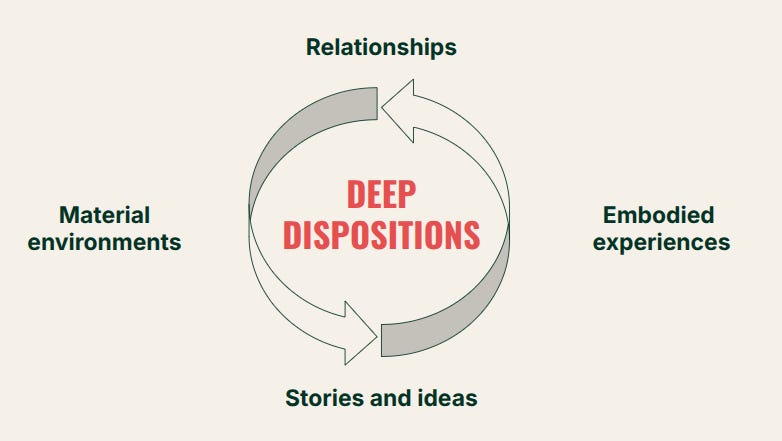
A key insight from our research is that there isn’t a switch inside of us that can get flipped from one deep disposition to another in perpetuity. Our environments will continually be influencing us. Instead of engineering ‘shift’ then, what seems more realistic is growing the contexts where people can inhabit different deep dispositions.
This article has been co-authored by Paddy Loughman, Ella Saltmarshe and Ruth Taylor. It builds on the work developed with others in the core team for this work, notably Jo Ram, along with c.50 other people detailed here.
Photo by Cosmin Andrei Buzamat on Unsplash

SEEING
How might we perceive the landscape of deep cultural formation?
We didn’t set out to create a new framework to answer this question of what taking deep dispositions seriously might mean for practice, but after months of trying to make sense of such a complex area, we found ourselves putting one together on our epic project Miro board. For better or worse, the complexity of the terrain had us gravitate towards shapes, layers, and colours to make sense of it. We’ve called this framework the Deep Canvas:
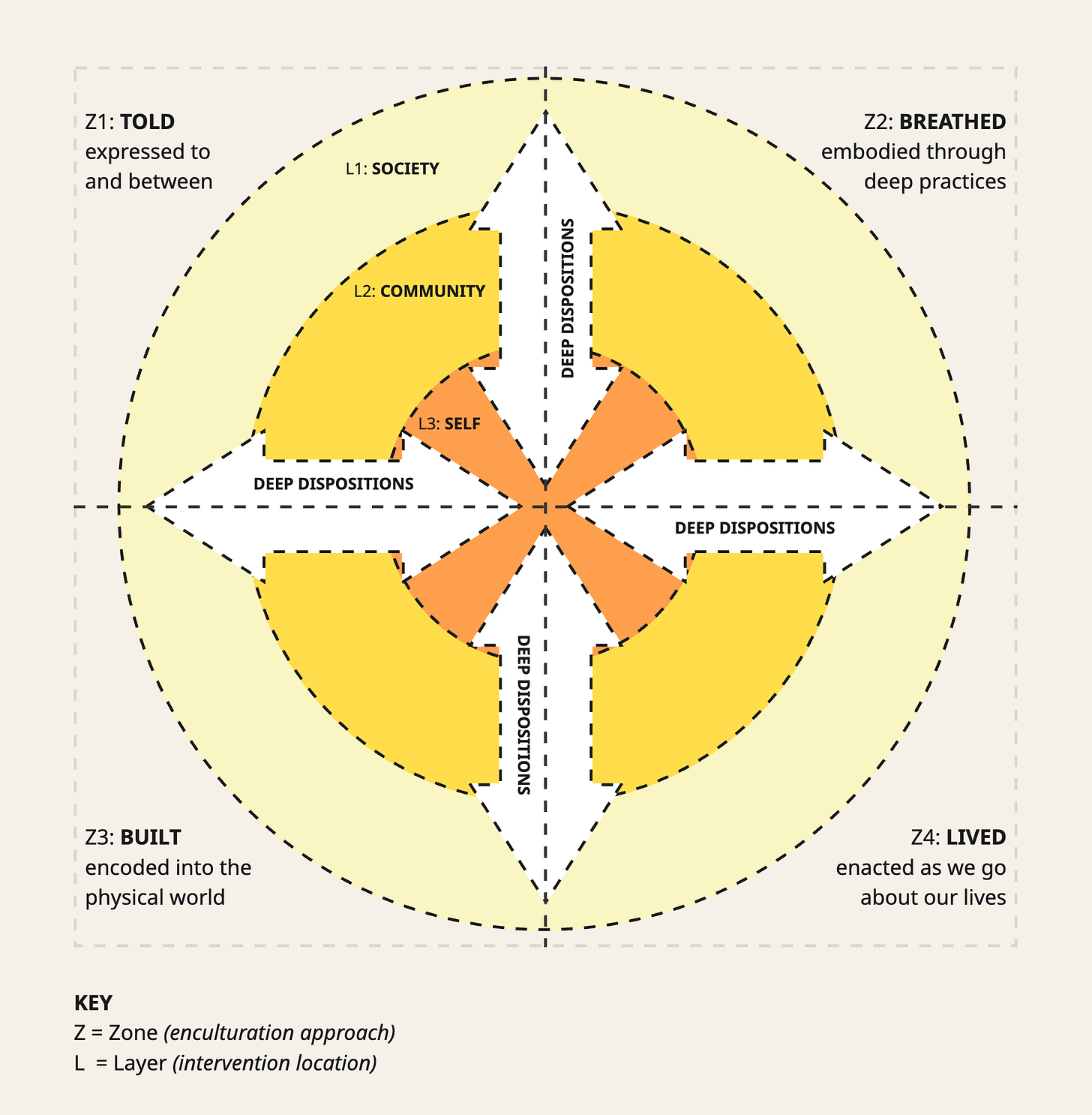
Central to the Canvas is the idea of enculturation: the lifelong process through which people learn their norms and worldviews – learn their culture. This concept2, which originated in anthropology in the middle of last century, initially focused on how culture was inherited, before expanding to acknowledge the multiple and messy ways we embody, enact, make sense of and remake culture. It happens through explicit teaching in schools, implicit socialisation as we observe and imitate others, embodied and material enactment, our rituals and built environment, and through symbolic and mediated expressions such as art and media.
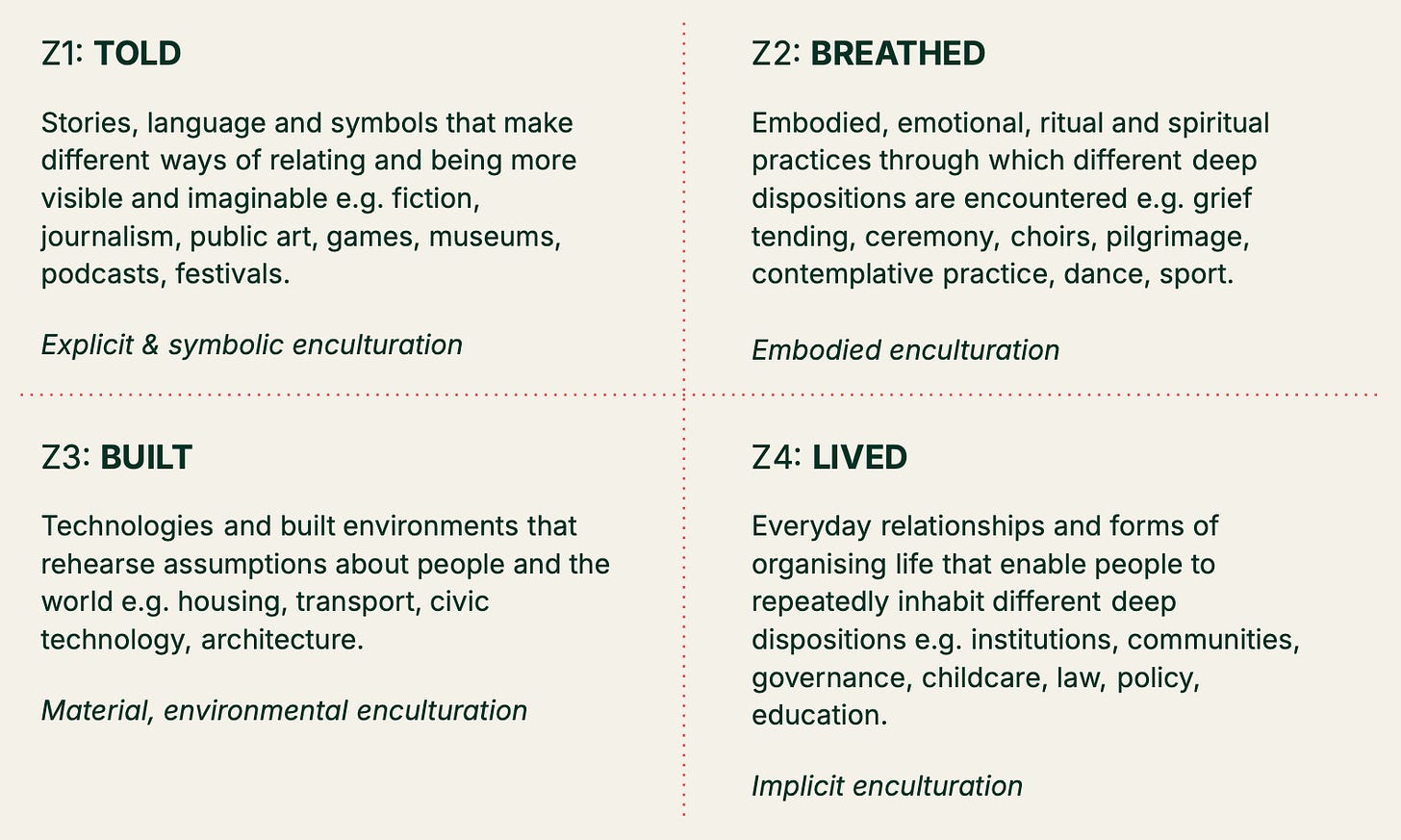
We turned this complex idea into the Deep Canvas, a simple framework to help us get practical. We’re seeing this as a prototype, which may well evolve. It has four zones: ‘Told’, ‘Breathed’, ‘Built’, ‘Lived’ (with loose, permeable boundaries).
We then layered these zones onto the nested circles of ‘Self’, ‘Community’, ‘Society’, based on a synthesis of various existing models3.
As soon as we built the Canvas we found ourselves using it in different ways: to map existing work, to explore gaps and connections, as well as helping us to pay attention to things we might not have otherwise. It showed the diversity of activities and structures that will be contributing to our deep dispositions, and highlighted the cultural significance of work that may not typically be thought of as ‘culture change’. For example, how the choices of teachers, town planners, technologists, architects, parents and many more people in all corners of society help shape the contexts in which particular deep dispositions become prevalent.
The canvas has sparked questions for us, like does work in any zone become more potent when tethered to the others? For example, told stories that relate to lived practice; breathed practices that relate to built projects; built projects that relate to told stories.
What we realised quickly though, was that the framework wasn’t a strategy, leading us to ask: “what could a strategy for doing this work look like?”
We didn’t particularly like the word ‘strategy’ in this context. Its military origins, along with language like ‘targets’, ‘impacts’ and ‘campaigns’, can orient us towards linear, binary, potentially aggressive activity that imposes itself top-down, seeks certainty and promises predictable results. Deep dispositions are reinforced by culture which is messy and emergent, so any attempt to engage with these dynamics won’t be linear or predictable. It is going to be met by different people who will experience it differently, depending on the countless other relationships, stories, structures and experiences that make up their lives.
So rather than suggest ‘strategies’, we’re going to suggest different ‘approaches’ to working with a deep disposition lens; and rather than a ‘theory of change’, they become a ‘theory of practice’.

DOING
What might seeing this way mean for action?
The Canvas helps us to see that there is a broad range of contexts that continually shape our deep dispositions, whether they’ve been designed with culture change in mind or not. As we’ve explored this, we’ve begun to see several overlapping possibilities for what approaches might look like in practice:
-
Supporting the development of contexts where people can experience different deep dispositions. This could be anything from lifestage rituals, to music, to a commoning initiative.
-
Bringing a deep disposition lens to existing work. A community energy project, for example, might consider what deep dispositions towards land, ownership and belonging are being enacted through how it operates and whether there are ways participants want to become more intentional about these, through how they do the work or how they talk about it.
-
Helping people notice deep dispositions in the world around them. This might mean creating opportunities to recognise and reflect on the assumptions embedded in stories, environments, everyday practices etc. that normally go unnoticed or unquestioned.
-
Exploring unlearning and deconditioning. This could include creative work and educational practices that explicitly create space to loosen deeply habituated assumptions.
These possibilities both invite new experimentation, and also show that there’s already deep culturally impactful work everywhere4. If we just take the Lived zone: repair cafes, mutual aid networks, citizens’ assemblies and community ownership projects already create social and material value in the here and now, whilst also having effects on our deep dispositions.
For example, a community garden can grow food and create community, and have implications for our understanding of our relationship to land and ownership. Or, a citizens’ assembly, which can have an immediate democratic function, can also create experiences of collectivity.
Noticing the possible deeper cultural influences of efforts doesn’t mean we can know in advance what their effects will be. A community garden can still reproduce exclusion, a citizens’ assembly can be competitive and fuel distrust. The invitation is to bring more intention, in their design and delivery, to their possible impact on deep dispositions and to pay attention to what happens.

ATTENDING
As we act, what happens? What might it help to pay attention to?
During our exploration, as we’ve thought about putting our learning into practice in our own work as practitioners, we’ve found it useful to return to a few questions, which we offer below.
These are our first attempt at creating some prompts that may help those interested in reflecting on the deeper cultural dimensions of their work. They’re not intended as a check for ‘doing deep disposition work correctly’. We’d love to hear your additions or suggestions.
-
Can this work be of benefit here and now, alongside the deeper cultural effects it might have?
-
Can it provide opportunities to embody experience or reshape relationships rather than simply communicating an idea or belief?
-
Can it generate opportunities for reflection and learning which can be shared with others?
-
What deep dispositions are we living as practitioners through how we’re conceiving and doing the work? What assumptions might be showing up in the organisation of the work?
-
What holds the current contexts in place, and who does that serve?

GATHERING
How might different experiments be organised so patterns become visible across contexts?
As already stated, we can’t expect any single intervention to ‘shift’ a deep disposition, and we can’t know for definite how a particular practice will interact with the wider cultural ecology, but this isn’t an excuse for paralysis.
It’s possible to work with informed hunches about practices and contexts that might interrupt dominant patterns or strengthen neglected ones, and then learn through trying them out. A portfolio of real-world inquiries could support experimentation across the different zones of culture, while bringing them into relationship to see what happens across different practices and contexts.
Individual experiments will have value in their own right, while variation across a portfolio helps answer questions like: what seems particular to a place or practice? What reoccurs in very different contexts? Where do initial hypotheses hold up over time and where do they need revising?
There are many ways to design a portfolio of work to allow different questions to be asked and different dynamics to be noticed, varying and holding different things to see what becomes visible. Here are four illustrative examples:
1. One place, multiple practices - Imagine a long-term inquiry in one neighbourhood or town, supporting a range of existing and new practices across the Canvas, like storytelling initiatives, changes to the design of public space, forms of local democracy and mutual aid, ritual, celebration or shared meals. Participants could begin with a deep disposition they care about – like experiences of individualism or interdependence – and ask how these patterns show up across different parts of local life, and how people might experiment with cultivating different contexts.
2. Similar practice, different places - Take broadly the same practice (like citizens’ assemblies) and support experiments with it in several different contexts. By bringing a deep disposition lens, we can investigate the deeper assumptions and ways of relating that emerge (around authority or expertise or community belonging for example) and notice what varies and what is similar across different places with their individual local histories, relationships, institutions, geographies and norms.
3. One deep disposition, multiple practices - Explore how a deep disposition we’re interested in (like ‘separation’) appears across different parts of the Canvas, and design interventions to experiment with offering ways to experience something different (like ‘interbeing’).
4. Different scales and timescales - A portfolio could also deliberately connect experiments operating at the level of individuals, organisations or communities, or compare intensive short-term interventions with practices that are sustained over years. This can enable exploration of how repetition, duration and scale matter to this work.

ENABLING
What conditions might enable this work?
Throughout the research process, we heard time and time again from a wide range of practitioners how vital infrastructure is to this work moving forward.
From the relational (or ‘solidarity’) infrastructure that builds support, to the learning infrastructure that helps the work evolve, to the physical infrastructure – the land, the buildings, the equipment – that makes it possible, and the infrastructure that underpins how this work is financed and governed. We’re developing more detailed work around these types of infrastructure that we can make available soon.
Given that deep dispositions are continually reinforced through relationships, institutions, economic arrangements etc., the way this infrastructure is designed and held will really matter.
Deep breath
Ok, that was a lot…
A recap:
Deep dispositions are continually formed and reinforced through our relationships, material environments, everyday practices and embodied experiences, and the stories and ideas we are exposed to. Taking deep dispositions seriously requires us to pay attention to a wide ecology of influences.
Culture is complex and continually being remade; we don’t stand as objective observers outside of it. But this messiness doesn’t prevent action. It’s possible to make informed hypotheses about the practices and contexts that might interrupt dominant patterns, strengthen neglected ones or make different ways of seeing and relating more available, and then pay close attention to what happens. Over time and across different contexts, this kind of experimentation may reveal recurring patterns that grow understanding about how deep dispositions change, as well as developing culturally reflexive ways of designing and delivering work in the here and now.
In this article, we’ve offered the Canvas as a way of conceptualising the terrain of this work, a set of questions for reflecting on the possible deeper cultural impact of existing work and some possibilities for assembling a portfolio of real-life interventions.
All of us are involved in deep disposition work everyday. Mostly in ways that are invisible to us. The way you breakfast, the construction of your home, the institutions you engage with, the posts you scroll through, the TV you binge, the way you relate to friends and family – all of these will be shaped by deep dispositions (and all have the power to shape them in turn).
Taking a deep disposition lens can help us start to notice what deep dispositions we may be reinforcing or unsettling. Ultimately it can give us more agency and ability to affect these deep cultural undercurrents that shape the trajectories of our lives.
We don’t know where this will lead, which we think is exciting. We’re practitioners trying to better understand this terrain and we hope the ideas unpacked here provide some useful ways to begin experimenting and building differently together.

Photo by Alma Snortum-Phelps on Unsplash
This phase of this work is being funded by Joseph Rowntree Foundation. For information about the previous phases and their funders see here.
As a team we have different feelings about and practices with AI and it is a very live conversation amongst us. Different articles in this series have used an LLM to different degrees. We are committed to AI-use transparency: in this article we used an LLM to critique an early draft and help surface hidden assumptions we were making (aware that it too is shaped by our culture, and in this case instructed to draw from a curated Obsidian vault that includes all of our research sources for this work). We used an LLM to review existing ‘strategies’ for deep cultural change, which we then critiqued and cross-referenced with our research.
Thank you for your time and attention so far; if you want to share any reflections or questions, you can reach us at: internarratives@icloud.com
We’re far from the first people to investigate this territory. Different fields and traditions have referred to it using different terminology, such as deep narratives, core values, mindsets, cultural soil, worldviews, social imaginaries, or epistem-ontological orientations (if you’re really fancy).
We found over 150 related concepts overall, there are undoubtedly more. We have an extensive Glossary of these, along with relevant frameworks and theories of change, and a Library of the 160+ sources we referenced in our research. We are building this into an accessible website that we will share soon.
A range of models suggest a ‘three-level’ approach to mapping our world, accepting that this kind of mapping is reductive and limited. A familiar one is ‘micro, meso, macro’ (e.g., a simplification of). Others include: ‘infrastructure, social structure, superstructure’ and ‘hyper-agent, institution, egregore’. There was a suggestion from some in our design group to include a fourth: biosphere, which is currently assumed by the model but not made explicit.
We’ve been gathering a database of some of this work, which we’re building into the website we’re developing.